

Issue
09Photography
Sharif Hamza
Words
Stylist
Elgar Johnson-Forster
Published
Updated
Reading Time
7 Min Read
As a new generation edges closer to becoming a golden one, Morgan Rogers sits front and centre of football’s next wave. The latest PFA Young Player of the Year has everything the winners of the past had: the ability to decide games, shift momentum and the expectation to become the player in whatever side they play for.
I interviewed Morgan directly after he received that award. Nearly a year later, we spoke again. This time, I wanted to understand the muse behind the freedom in his football and the growing presence he carries away from it too.

In an era built on noise, algorithms and clickbait, I can understand why those at the very top sometimes shy away from individuality, while others lean into it completely. Morgan, I feel, is the latter.
Whilst many players who reach his level arrive in the Premier League during their late teens, Rogers took the longer route. Three loan spells away from Manchester City before eventually finding his footing through Middlesbrough and then Aston Villa.
“I wasn’t ready to go through Man City’s academy and just be like, ‘Chuck me in Pep, I’m ready to go.’ I was nowhere near that”
— Morgan Rogers
MR: “Everyone’s journey is different and everyone goes through different things. I needed that to shape me because some people, like Phil Foden, are ready to go at 17 and just play. They are that good. And I wasn’t at that stage.

“I wasn’t ready to go through Man City’s academy and just be like, ‘Yep, chuck me in Pep, I’m ready to go.’ I was nowhere near that. I needed to learn about myself as a person, about myself as a player, what I was going to look like at an elite level. I needed to go away and go through those difficult times.”
Perspective is something most of us could barely spell at 23, yet it was the thing that came through most throughout our conversation. The challenges, setbacks and pressure to Rogers, all of it matters.
“Three different loans, three different fan bases, three different times. That allows me to be me now”
— Morgan Rogers
MR: “One minute everyone loves you, one minute everyone hates you. I kind of got that in three different loans, for three different fan bases, at three different times, battling for three different things. That allows me to be me now.”

As a millennial speaking to somebody from Gen Z, there is always that strange internal conflict: being grateful we grew up during the first wave of social media, before engagement and visibility became currency, whilst also admiring a younger generation far more comfortable expressing themselves fully and more importantly, expressing an identity beyond simply being a “footballer”.
“We’re not just footballers. We have a life too. We have different interests. We all want to express ourselves”
— Morgan Rogers
MR: “I think in England people don’t really care about stuff like that as much. It’s seen as a negative, like you don’t care about football. Our generation are trying to change that. We’re not just footballers. We have a life too. We have different interests. We all want to express ourselves.”

That sense of expression runs through Rogers’ identity. Football is still the centre, but music, fashion and culture clearly matter. Whether it’s clocking NBA tunnel fits, taking notes on what artists wear he embraces the spaces where sport and culture now overlap.
“Yeah, this is football’s best-dressed generation. But people are losing their way a bit”
— Morgan Rogers
MR: “Music artists, the way they are, how out there and outgoing they are, I’m always the first one to check what people are wearing, who they’re turning up with. Basketball is the same. It has a big influence on fashion.”
I follow up by asking whether this is football’s best-dressed generation.
“Yeah,” he laughs. “But people are losing their way a bit.”

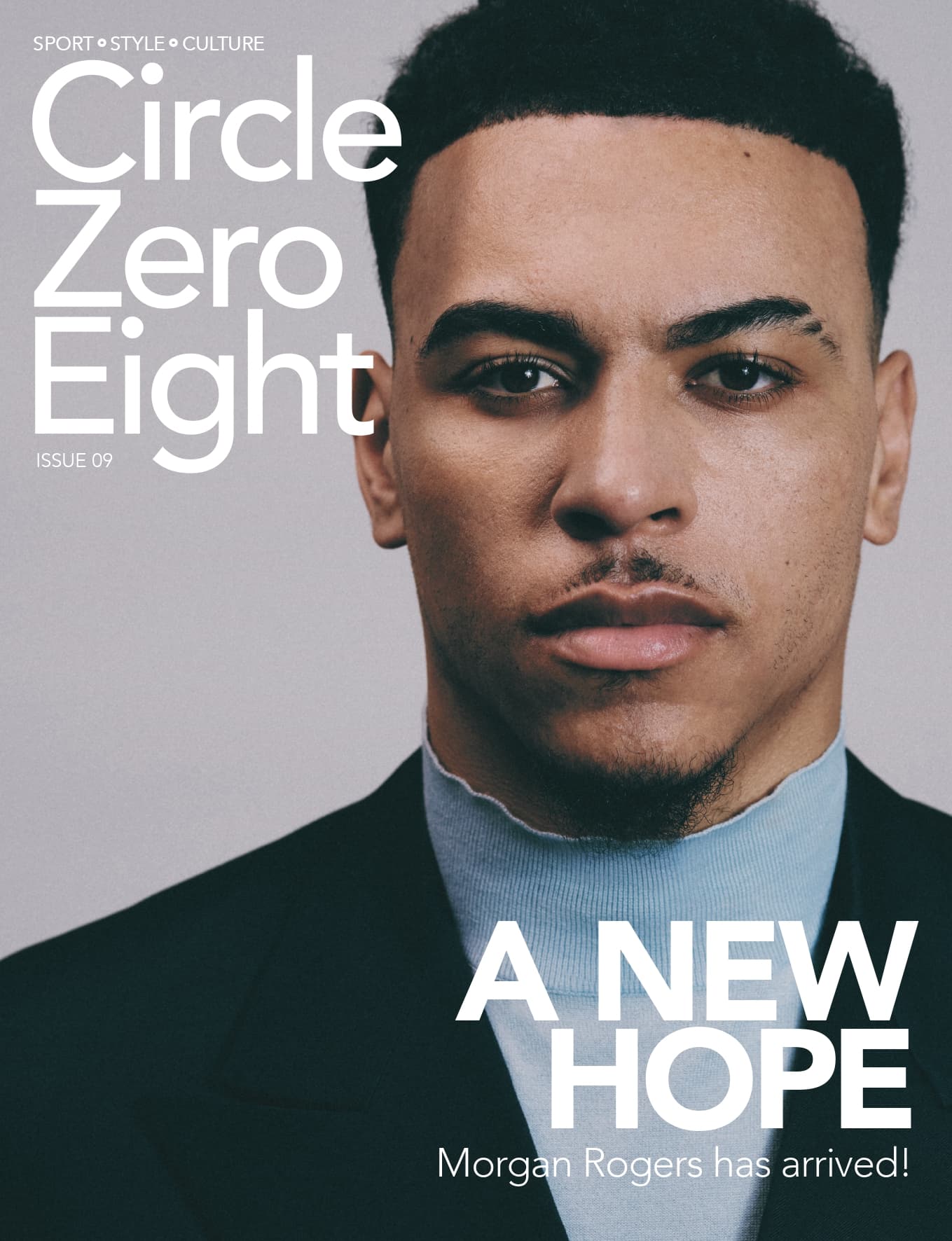
A quick scroll through Morgan’s Instagram and it is obvious he is embracing every part of who he is whether that’s courtside at an NBA game or with Burberry during London Fashion Week. His generation are not only comfortable in spaces outside football, they are also helping shape them.
MR: “You’re around these people and it’s like a pat on the back. You deserve to be here too.”
There is a confidence in this generation that previous eras of English football perhaps never fully embraced. For years, personality away from the pitch often felt like something players had to apologise for. Rogers’ generation seem less interested in asking for permission.

The crossover between music and football now feels closer than ever. Some musicians would probably trade a headline festival slot for a goal at Wembley for England, whilst some footballers would happily swap boots for a mic for the day. Either way, it feels like a win for culture, and is giving us crossovers we always needed.
MR: “My brother’s in my ear like, ‘Morgan, that’s Kano I need a picture.’ I listen to Kano as well, but I’m trying not to do too much.”
“When you get on top, you quickly get knocked back down. There’s always a ‘but’”
— Morgan Rogers
We stayed on music for a while. Partly because Kano is the GOAT, but also because I wanted to understand where somebody who never misses when choosing a song for an Instagram dump, gets inspiration from. The answer ranged from Lil Baby to Bill Withers.
MR: “That’s what I’m saying,” he smiles. “It depends how I’m feeling. Sometimes all that other music is too much. I just need a feel-good song, a pick-me-up song.”
In interviews with elite athletes, there are moments where they briefly forget the media training, forget the cameras and just speak honestly. Those are usually the moments that make a conversation memorable. The moments where you see the person before the footballer, I have seen these every time I’ve sat down with Morgan. But outside of interviews, in a world where footballers are constantly watched, analysed and judged, it’s easy to understand why vulnerability and expressing oneself can become difficult.

On the trade-off that comes with modern football, Rogers is honest.
MR: “You have to be careful where you go, who you go with, how it might look. I’m used to it now, but it can be tough sometimes.”
“I try my best to be the best version of myself that’s possible. I think that’s the minimum I owe when I know there’s people watching and watching my behaviours and the way I am. Of course you’re not perfect and you don’t always get it right, but you try your best to be the best version of yourself.”
What stood out most though, was the underlying determination for improvement. The sense that even after breaking through for England, winning awards and becoming one of the Premier League’s standout young players, Rogers still views himself as unfinished.
There is no arrival point in his mind. The destination keeps moving once the old one is achieved.
MR: “When you get on top, you quickly get knocked back down. There’s always a ‘but’. He’s had a good season, but can he go again? But can he do it here? Can he do that?”
That, more than anything, feels like the fuel that gives us the Morgan Rogers we see in the white of England or claret of Villa.
MR: “I want to answer those questions. This is why I deserve to be here. This is why I want to go to the next level.”
At 23, Rogers speaks less like somebody overwhelmed by the spotlight and more like somebody curious about how far he can push himself within it. The ambition is obvious, but so is the self-awareness. He knows football changes quickly. That praise is temporary. That expectation only grows. Yet beneath all of that is a calmness and the willingness to accept the challenge.
MR: “Everything can happen so quickly in football. There are so many opportunities to show what I’m about. It’s hard to say, ‘This is it now.’ I just want to see how far I can take it.”
And maybe that’s what makes Morgan Rogers feel so representative of this new generation. Comfortable in culture, comfortable in himself, but still chasing the next level.


